Owning Digital Money
To understand what blockchains are about, let’s dive right into the age-old example of owning digital money:
- When you own $1000 in your bank.
- When you own $1000 in the Bitcoin network.
How is it that we trust each of them to exist and be credible?
Bank
In the former, as little as one computer in the world, owned by the bank, can store the information that you own $1000. When you want to transact with your $1000, you need to authorize yourself to this one computer.
And why do we trust that one computer that the bank holds? Probably something that we take for granted and don’t bother too much with questioning. But if you dig further, you will soon see that banks are trustworthy because they are backed by a central bank. Central banks are backed by a government and audited by regulators. Finally, governments have access to military, which is the ultimate reason we trust the system: law enforcement.
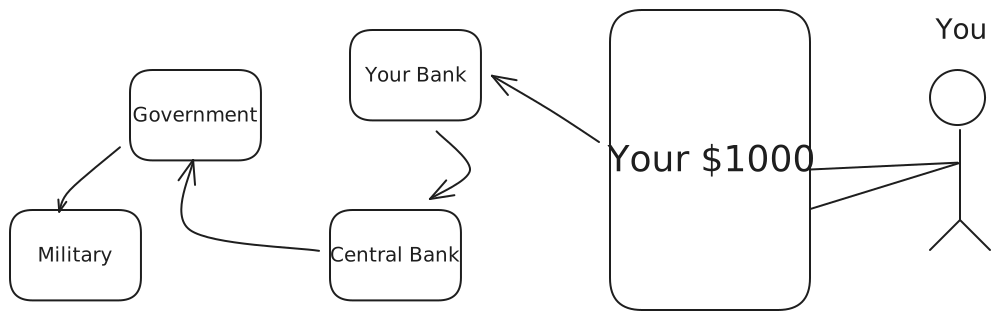
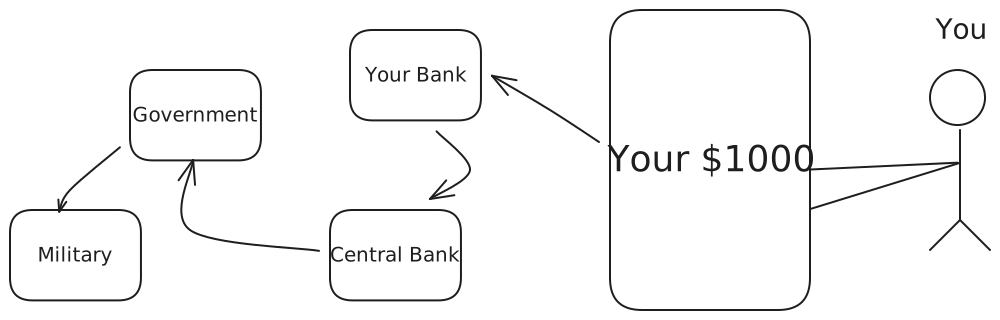
All such forms of trust have a critical property in common: they are based on humans acting based on a set of rules, not hard-science. And this entails:
- They are corruptible12: the human(s) in charge might decide to take a different action than what the rules expect them to do, or not do anything at all. This is especially self-evident in people in positions of power, because “absolute power corrupts absolutely”.
We call these entities that we create, and then put our Trust into to let us transact on contentious matters, such as money, an Authority. A bank is a societal authority that we Trust to handle ownership and transfer of money for us. Read more about this in Need For Trust.
Bitcoin
With the advent of Bitcoin, a number of thinkers started to imagine: how could we build a system that is as trustworthy as the aforementioned, yet its reasons for trust are rooted not in humans, but rather in hard-science and well-understood laws thereof? Such trust would consequently not be susceptible to any sort of corruption. It would instead be: verifiable trust.
In the Bitcoin network, such branches of hard-science are most notably cryptography, economics, and distributed systems. The main discovery of Bitcoin was that if one combines these branches of science together, they can build a system that is equally trustworthy of behaving according to certain rules, yet it requires no Trustworthy human to sit in the center.
And the Bitcoin network is exactly one example of that: a simple bank, giving the ability to anyone to open an account in it, with basic rules that allow store and transfer of value, all without a human-based dAuthority sitting in the middle.
Bitcoin’s main novelty is demonstrating that creating an Authority with science-based trust is possible, and people are willing to store their wealth with this Authority.
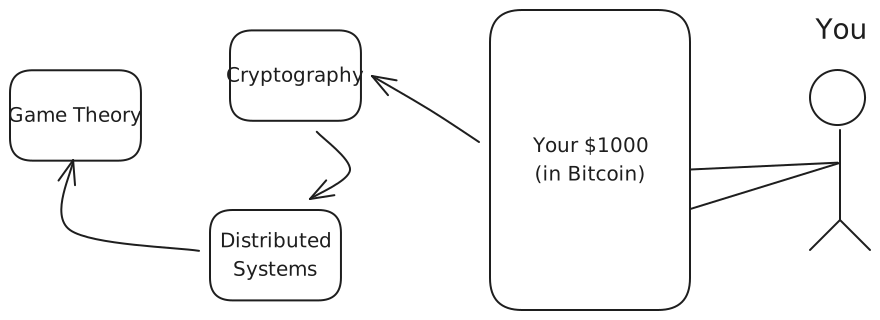
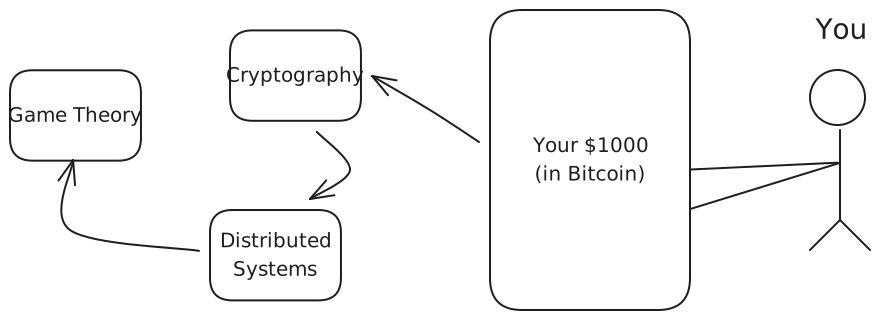
Cryptography and Military
One of the pillars of the traditional banking system is for you to visit a branch, provide some documents and a signature, and sign up for an account. Perhaps you would also provide a password in person, which you can later use with a card to authenticate yourself. This process is human-based and works most of the time, but we can be sure that there have been cases of impersonation in a bank branch. Yet, thanks to the existence of trustworthy law enforcement in our society, we are okay with this system.
In contrast, in the Bitcoin network, public-key cryptography is used to authenticate users. This is a very well-known method3 to allow one to digitally sign information and attest to the ownership of a key.
Public-key cryptography doesn’t work because an employee at a bank branch does their job correctly. It doesn’t work because a given country has a very powerful central bank, regulatory bodies, and law enforcement. It works because of hard-science determining it works, no matter who or where you are and with whom you are interacting. This crucially removes the need for law enforcement from the Authority of Bitcoin.
Commoditization
Establishing a bank and a currency is not something that I can go on and do by myself. The nature of human-based trust is that it is not accessible to all. This is no fault of any particular person, but rather the inherent property of this type of Trust. A strong array of regulatory and law enforcement apparatus is needed to ensure the correctness of an Authority relying on human-based trust, and therefore it is not very accessible.
In contrast, science-based trust requires little to no overhead to ensure its correctness and therefore can be established by significantly more people, if not by anyone.
This is exactly a step towards a process known as Commoditization: a product, once seen as special, becoming more and more accessible to the public. Twenty years ago, starting a casino or launching an IPO was a complicated, highly regulated process. Today, almost anyone can launch a token using blockchain-based technologies, or start their (mini) casino by launching a smart contract or a meme-coin. Decentralized Exchanges can allow this new token to be traded with other value-bearing tokens, organically determining its price in the open market.
Therefore, we can add a new property to each category of Trust: accessibility.
Contention
Before we conclude this chapter, it is crucial to reflect on what the word Authority implies: blockchains are means to create digital authorities, and authorities are meaningful when there is contention involved. That is, the matter at hand has a value-bearing aspect to it, and therefore individuals won’t trust each other directly and need an authority to begin with. See more in Blockchain and Contention.
Summary
This is really what blockchain-based technology is all about: commoditizing the ability to establish an Authority and embed Trust in them, with superior properties of science-based trust, compared to those of human-based trust.
Human-based trust is corruptible and limited. Science-based trust, such as that of Bitcoin, is verifiable and accessible.
There is a third property: that science-based trust is often auditable, at least in the way implemented in blockchains. More in Execution, Ordering and History.
We summarize these properties that blockchain systems bring about as Trustless. Blockchains are a way to establish Trust without needing to trust a human or an entity controlled by humans anywhere, ergo Trust-less. When we take these properties and apply them to the web, we then call that Web3.
Bitcoin was the first demonstration that you can do this. It was the first digital bank, establishing Trust without a human-based Authority. This was the first step towards the commoditization of digital money.
Ethereum took the same idea to the next step and allowed more general forms of computation to be executed in the same Trustless manner. We explore this flexibility further in Evolution of Blockchain State Machines.
One of the first demonstrated examples of more general forms of computation was a standard like ERC-20 on Ethereum, allowing anyone to create a token that is tradeable against ETH via decentralized exchanges. This was extensively used for fundraising in the form of ICOs.
Don’t be mistaken: most of these ICO tokens ended up being absolutely worthless. But the crucial point is that the creation of them was no longer bottlenecked by the lack of trust. Their value converging to zero is not a sign of any shortcoming in blockchain systems, but rather their advantage: because ANYONE could now create a token, of course many of them ended up being worthless.
Next
Now, you might ask, can I use blockchains to establish trust in any scenario that requires trust? The simple answer is: not without some compromises. Blockchains are at the end of the day digital systems and can work with digital bits, just as a normal computer program does. In the next chapter, Blockchain-based Authorities, we model an Authority further to look into why.
Footnotes
-
As said by Yuval Noah Harari in his famous TED talk, humanity’s ability to establish such human-oriented institutions and giving them power is arguably the main reason for our advent, yet as we have seen in many anecdotes, it is also our Achilles’ heel: we are not enlightened Elves, nor sturdy dwarfs, but rather greedy, corruptible humans. When given power, we sometimes rush to abuse it. ↩
-
You can similarly see traces of this in the founding fathers of America, trying to limit the amount of power given to the federal government. ↩
-
It is not an overstatement to say public-key cryptography is the backbone of the entire internet. Every time you open a website which uses HTTPS, this technology is used at least multiple times. ↩