Then, drawing upon the Sequential Blockchains analogy of seeing the entire validator set as a single-threaded CPU, we can build our first sharded blockchain design:
If I have 1000 validators that are securing one blockchain, what if I have 2 blockchains that are each secured by 500 validators?
In a sense, we are Sharding a single blockchain to be multiple blockchains, therefore the name of this chapter.
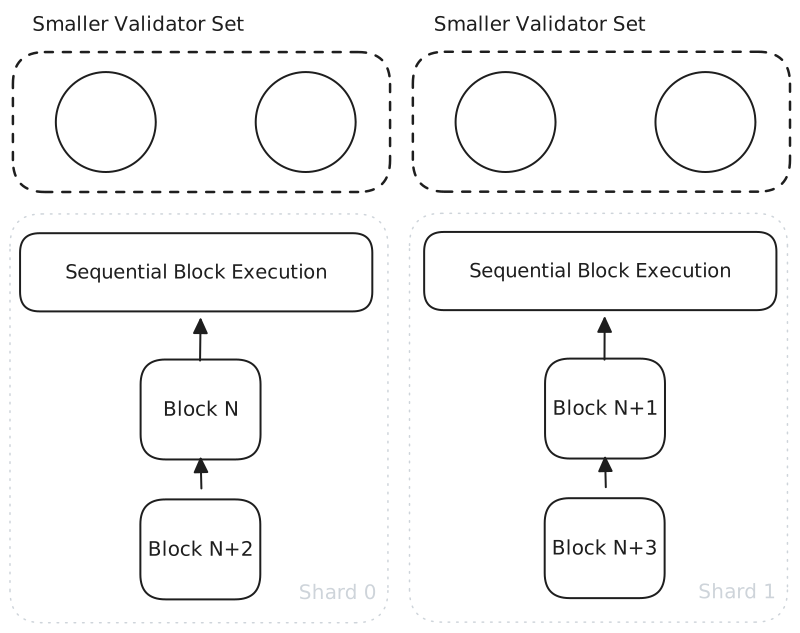
In the above diagram, Block N and N+1 are essentially being processed in parallel, as if we have a 2-core CPU.
This would indeed double the throughput of the overall system, but it poses multiple downsides:
- The Economic Security of each shard is now half, therefore the Trustless properties are also potentially halved.
- We must in some way ensure that there are no conflicting updates between what happened in Block N and N+1 and deal with them, as they are processed in parallel.
- As noted in Overhead, the communication between these shards will become slow and asynchronous. It is no longer trivial for a smart contract in one shard to communicate with a smart contract in another.
- Then, we might be able to trace the same Weakest Link issue in this model as well. Imagine we have a multi-chain setup, where the Economic Security among different shards varies from one another. But, these shards are interconnected, and are sending value-bearing tokens to one another. The likelihood of this system failing is now equal to the likelihood of the weakest shard failing.
- In some sense, this naive way of sharding is lowering the Byzantine Threshold of the whole network.